
Blog Written By Brandon Evans of Soccer Post Huntingdon Valley
To play soccer, there are some essential things you need, one of which is a jersey. The FIFA World Cup is the pinnacle of soccer in every respect, and it is often the pinnacle of soccer jerseys as well. It’s a showcase for some of the most creative and iconic designs fans have ever seen.
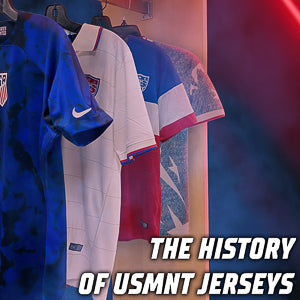
A lot of pressure rests on the kit manufacturer making the World Cup’s host nation’s jersey every four years, and 2026 is no different. Before the USA’s long-awaited jerseys for this year’s tournament officially drop, let’s take a look back at the kits American players wore as they represented the Stars and Stripes in World Cups past.
The History of the USA's World Cup Jerseys
1930
Going back to the origins of the United States’ national team at the turn of the century, their kit was rather rudimentary, as was that of most teams of the era. This style carried over into the 1930 World Cup in Uruguay, where the US was one of only 13 nations to participate.

At this tournament, the Stars and Stripes donned a basic long-sleeved white top with navy-blue shorts. The crest itself was simple but iconic, featuring a vertical array of red and white stripes under a few stars in the shape of a shield. The US did not have an away kit and wore only the white home kit, which was common at the time.
1934
Four years later, the USA qualified for the 1934 World Cup in Italy.

The jersey brought to this tournament was essentially the same long-sleeved top as the 1930 World Cup, with an identical crest, collar, and everything else. The sole difference being that this shirt was blue rather than white.
1950
It wouldn’t be until 1950 that the USA played in its next World Cup. In Brazil, the USA brought a kit that would be remembered for ages, despite utilizing the same white template as before and a similar crest.

What defined this shirt was the single red diagonal stripe that went across the torso. Akin to famous teams at the time, such as River Plate or the Peruvian National Team, this design would break barriers, setting the stage for more creative jerseys in the future.
1990
This tournament marked the first time the US went to the World Cup with a jersey made by a commercial kit manufacturer rather than in-house, and the first time they had both a home and an away jersey. For the years leading up to this tournament, adidas had been producing jerseys for the USA, and at this World Cup, their home kit was a basic white adidas template from this era with thick navy-blue chevron-like stripes on the sides.

One particular aspect of this jersey, new to the US, was a centered badge, an updated version of the classic design from the beginning of the century. The away jersey was the same template, but in light blue instead of white, with white stripes instead of navy blue.
1994
Knowing the 1994 World Cup would be their last jerseys for the US, adidas produced two masterpieces that would go down as the most iconic in US soccer history. The home was a white template with a navy-blue collar around the neck, while the torso was adorned with wavy red stripes that looked like an American flag fluttering in the wind.

The away was even more notable, featuring a light blue shirt made to look like denim, with faded white stars on one side of the midriff. The crest was also updated, now with the letters “USA” spelled out with a soccer ball in the center. For many American soccer fans, these are seen as the gold standard.
1998
When the US went to the 1998 World Cup in France, they turned up with Nike jerseys for the first time, the kit manufacturer they have stayed with to the current day. Unlike the jerseys from four years before, these did not feature intricate designs meant to represent American culture and history in complex ways; they were simpler Nike templates of the era, donned in America’s colors.

The home was a white shirt with a navy-blue collar and a single horizontal navy-blue stripe, both accented by a red outline. The away jersey was identical, but with the red and white colors swapped. The crest was updated yet again, combining the previous designs with the letters “USA” and a soccer ball now inside a shield of stars and stripes. This was also the peak of intentionally baggy jerseys.
2002
Similar to the jerseys from 1998, the 2002 shirts were also Nike templates. The home retained the white background and collar, but this time it featured dark red and navy-blue triangular shapes on the sides and under the arms, with red accents elsewhere on the jersey.

The away was a similar template, but instead of white, it was a darker blue with white triangular shapes down the sides and a regular collar. Like 1998’s design, these jerseys maintained the very baggy look.
2006
The jerseys that Nike produced for the 2006 tournament paid tribute to the famous 1950 kit, as both featured a stripe. Maintaining the white background, the home had dark red and dark blue vertical stripes running underneath the badge.

On the other side of the chest was a bright red Nike swoosh that really popped against the white background. The away jersey had a markedly different layout, featuring a navy background, a large bright white collar, and a thick horizontal red stripe across the midriff, broken by the player’s number.
2010
This year’s home jersey was a relatively basic white top with a faded navy-blue diagonal stripe across the torso and red and navy accents on the collar and shoulder cuffs. Keeping the same format, the away was a dark navy top while the sash was white.

These jerseys also featured an intricate eagle graphic on the inside of the shirt and incorporated state-of-the-art technology to make the shirt as light and breathable as possible for the player. By this point, soccer jerseys like this were much tighter-fitting than the older, baggy look.
2014
The team’s home jersey at the 2014 World Cup was more traditional, mirroring the first kits the US wore, featuring a slick all-white design with a classy collar. The away shirt, on the other hand, was divided into three parts. Blue on top and red below with a white stripe separating the two, representing the colors of the American flag.

During this tournament and over the years, this kit has become very popular, and due to its resemblance to the famous popsicle, it's colloquially known as the ”Bomb-Pop” jersey.
2022
After missing the 2018 World Cup in Russia, the USA made their World Cup comeback at Qatar 2022 with a pair of ambitious jerseys. The home kit’s white background remained, but this time the badge is centered, with the Nike swoosh on both shoulders instead of sitting next to the crest.

Small navy and dark red geometric shapes sat on the collar and shoulders above the Nike swoosh. The away was also a different take on America’s colors, with an all-blue top and a darker marbling design. These two kits also mark the first time the new USA crest was seen at the World Cup, a more minimalist version of the older USA badge.
2026
What will the USA’s jerseys look like in 2026? Follow Soccer Post on Social Media to see the new designs when they drop, and visit your local Soccer Post to rep the Red, White, and Blue!


